
Treating Radiation Exposure with Iodine

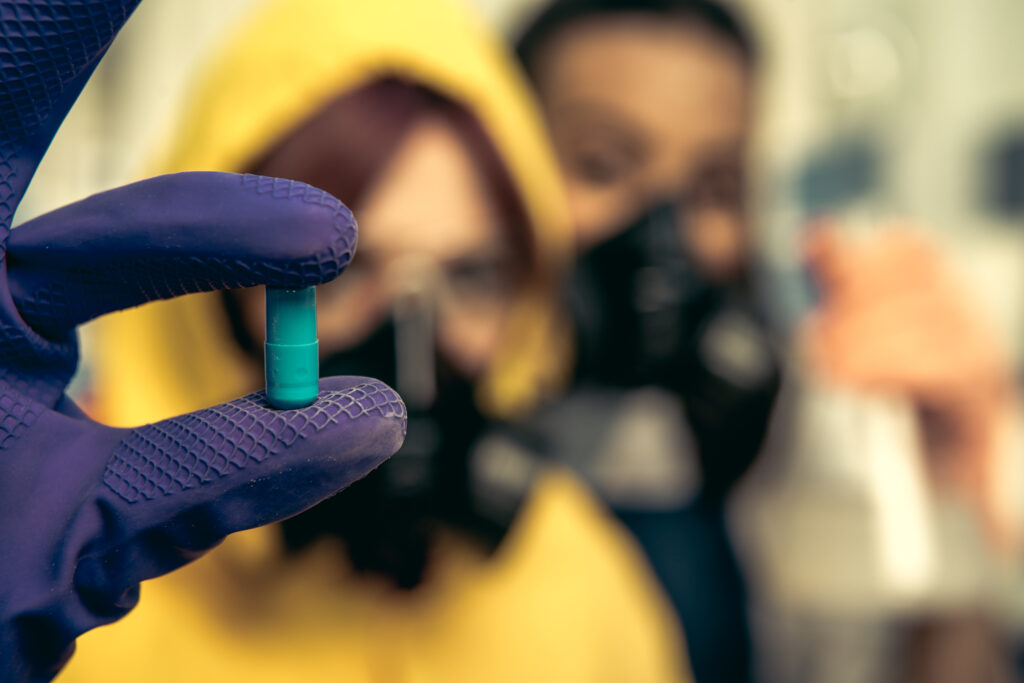
Nuclear Radiation can cause exposure to Radioactive Iodine in the Thyroid Gland. Potassium Iodide can help block the absorption of radio-iodine in the thyroid.
RADIATION EMERGENCIES KI TREATMENT
POTASSIUM IODIDE (IOSAT) to block RADIO-IODINE
- Radioactive Iodine accumulates in the Thyroid Gland.
- The Thyroid Gland cannot tell the different between Radioactive Iodine and Regular Iodine.
- You can ingest iodine by swallowing it or even breathing it.
- The Thyroid Gland will absorb whichever is there first (in a 24-hour period) until it is full.
- Too much Iodine can damage your Thyroid Gland permanently.
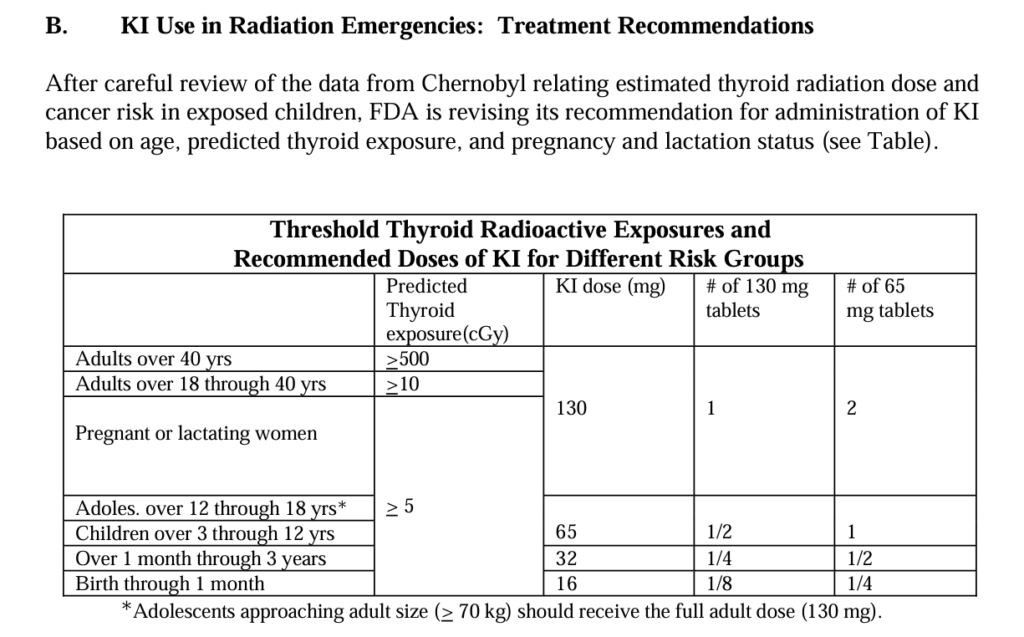
- Most adults over 40 are not recommended to take Potassium Iodide

FDA-Approved Treatments
- IOSAT
- Thyrosafe
- Thyroshield
- Mission Pharmacal
Want to Learn More?
Related Articles:
FAQ
Q? Is potassium iodate in fine powder form usable too? I found some 0.3 oz ACS reagent grade bottles on eBay
A: Personally, I would purchase supplements if I couldn’t find any of the only 4 FDA-approved IOSAT, Thyrosafe, Thyroshield, Mission Pharmacal products.
Q? What about lugols iodine? I know it’s potassium iodide.
A: Yes, according to Dr. Alton, Lugols 2%, taken orally, at 2ml is equal to the 130mg of Potassium Iodide dosage.
Q? What if I already have hypothyroidism, what should I do?
A: According to the American Thyroid Association, you can still take this treatment.
NOTES & SOURCES
The majority of information came from Sources #1 & #2.
All about Iosat, what Potassium Iodide is good for, what it can’t protect you against and what else you can do to protect yourself if you can’t find it.
ABOUT IODINE
Iodized Salt: You have probably heard someone use the excuse that they need to add table salt to their food because they need the iodine. It’s true; the human body does need iodine to function properly.
An estimated 29% of the world’s population is iodine deficient. That’s roughly 2 Billion people who aren’t getting enough of this essential nutrient. (13)
60% of the iodine in your body is in your thyroid. The thyroid is there to help regulate your energy levels, mental clarity, memory, mood, metabolism, weight, and more. (13)
RADIACTIVE IODINE (RADIOIODINE)
In the event that an accident occurs at a nuclear facility (a nuclear power station; nuclear reactor; or facility that separates radioactive isotopes, processes or reprocesses used nuclear fuels, or stores used nuclear fuel), the radioactive materials (substances that emit radiation) released to the environment from the facility through vents, etc., include iodine, cesium, strontium, plutonium, and others. The radiation emitted by these substances damage the DNA of cells. This is the main cause of health damage by radiation. (12)
If the radioactive iodine released by nuclear power facilities enters the human body through inhaling or ingestion it, approximately 10-30% of the amount incorporated will accumulate in the thyroid gland within 24 hours of contamination, and most of the remaining radioactive iodine will be eliminated from the body by the kidneys in urine. (12)
How much fallout is radioactive iodine? 3%?
Among the fission products formed in a nuclear power reactor, radioiodine is one nuclide of particular concern. Uranium-235 usually splits asymmetrically and radioiodine (I-131) falls in one of the favored mass number regions of the fission products (bimodal distribution with peaks between 90–100 and 130–140). Moreover, the fission yield of iodine-131 is relatively high with about 3% (the yield is the number of a particular radionuclide produced for every 100 fission events), and because of its high volatility, radioiodine is readily spread in different physical forms like gaseous inorganic, gaseous organic iodine, or adsorbed to particles (15)
Has a half-life of only 8 days. Loses half of its potency after each 8 days.(?)
The 131I isotope has a half-life of 8 days and emits γ radiation and β particles. Given orally, it is concentrated in the thyroid, where the β particles destroy the gland.
Iodine-129: 15.7 million years (19)
The uptake fraction into the gland in healthy people amounts from 10 to 40% of the intake into the body and about half of this amount enters the gland within 3–6.5 hours. (15)
At the Hanford Site in Washington State, radioactive iodine (129I), a fission product of plutonium, was discharged in 200 West Area disposal cribs. This discharge is responsible for the majority of 129I contamination found in the groundwater (Zhang et al. 2013). The 200 West Area contains two separate plumes covering 1,500 acres where 129I concentrations are ~3.5 pCi/L. (14)
Germany’s Federal Ministry for the environment
nuclear power plant disaster can affect radius of 100km (62mi)
the exposures resulting from radiation releases at the Hanford Site in Washington State in the mid1940s and in association with the nuclear detonations at the Nevada Test Site in the 1950s were
extended over years, rather than days to weeks, (3)
When we breath in air containing radioactive iodine, it will enter the blood and accumulate in the thyroid gland.
POTASSIUM IODIDE
Misnomer “anti-radiation” pills
Potassium Iodide is a non-radiactive iodine salt that can help block radioactive iodine from being absorbed by the thyroid gland.
How long does KI remain effective?
5 years liquid bc
hot humid environment bad bc of hydrolytic loss of iodine vapors
10 year shelf-life pills (dissolvability only issue (6))
effectiveness may be longer for pills
How does it work? Once the thyroid becomes saturated, it cant absorb more iodine for 24 hours. Although I did read that an alternative continued to block iodine abosrorption 8 hours after given, which implied that Pot Iodide stopped working prior to that.
WHEN TO TAKE IT?
Timing of administration and effect of iodine (12)
(Source: Preston LD, et al.1)
Administration 24 hours prior to exposure to radioactive iodine Protective effect of 90% or higher
Administration 8 hours after exposure to radioactive iodine Protective effect of 40%
Administration 24 hours after exposure to radioactive iodine Protective effect of 7%
The dose of this thyroid exposure can be averted by taking iodine (127I) within 24 hours before intake of radioactive iodine. This measure has been also reported to be effective for blocking radioactive iodine in the thyroid if iodine is administered within four hours after intake of radioactive iodine.2 (12)
When a healthy adult takes iodine, the concentration of iodine excreted in the urine peaks within 1-2 hours of taking the preparation, the amount of iodine in the urine gradually decreases, and the most of incorporated iodine will be eliminated from the body within 72 hours. (12)
If you can test for radiation with a dosimeter:
Increased Risk Levels:
500 cGy for adults 40+
25 cGy to be avoided risk assessment (3)
10 cGy for teens (3)
5 cGy risks cancer increased for children (3)
In Chernobyl as well as in Fukushima radioactive material was released repetitively over 7–10 days. Radioactivity release was most important the first day (April 26, 1986: > 2000 PBq day−1) and far less in the further course (roughly between 200 and 500 PBq day−1) (15)
IODINE LIMITATIONS:
KI does not: (11)
• protect against any other radioactive substances, e.g. radioactive caesium. It is not a generic radiation antidote.
• protect against external radiation, e.g. from radioactivity deposited on the ground, on surfaces, or on foods.
• prevent radioactive iodine from entering the body, but does prevent its accumulation in the thyroid
Iodine cannot prevent radioactive one from entering the body. Iodine is only effective for reducing the internal exposure of the thyroid gland to radioactive iodine and cannot reduce the dose of exposure to radioactive materials other than materials. Furthermore, administration of iodine will not treat injury of the thyroid gland or make the thyroid release radioactive iodine restore the thyroid gland after incorporation. (12)
Potassium Iodide cannot protect the rest of the body from radioactive elements and cannot reverse any damage once done, it also only protects your thyroid from radioactive iodine, not from any other radioactive elements.
IODINE DOSAGE:
Increase Effectiveness:
– Sooner you take it, the more time the thyroid will have to “fill” up.
– Minimize Exposure
Max Recommended Dosage for Iodine (13)
The daily upper limits for iodine include intakes from all sources—food, beverages, and supplements—and are listed below. These levels do not apply to people who are taking iodine for medical reasons under the care of a doctor.
Life Stage Upper Limit
Birth to 12 months: Not established
Children 1–3 years: 200 mcg
Children 4–8 years: 300 mcg
Children 9–13 years: 600 mcg
Teens 14–18 years: 900 mcg
Adults: 1,100 mcg
(1,100 micrograms = 1.1 milligrams)
Potassium Iodide only
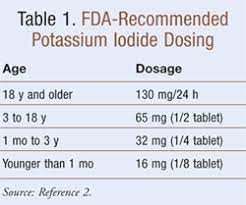
FDA has made recommendations on the lowest effective dose (4)
Newborns-1 month 16mg
1mo-3yo 32mg
3-18yo 65mg
>150lbs 130mg
(130 milligrams = 130,000 micrograms)
Pills can be dissolved.
Adults 40+ have the lowest chance of developing thyroid injury aftr exposure and are most likely to have adverse reactions from Potassium Iodide.
So, obviously, treat children first.
SIDE EFFECTS/ADVERSE REACTIONS:
*can react to or interfere with some medications.
Skin rashes
Swelling of the salivary glands
“Iodism” (metallic taste, burning mouth and throat, sore teeth and gums, symptoms of a head cold, and sometimes upset stomach and diarrhea)
An allergic reaction can have more serious symptoms. These include fever and joint pains; swelling of parts of the body (face, lips, tongue, throat, hands, or feet); trouble breathing, speaking, or swallowing; wheezing or shortness of breath. Severe shortness of breath requires immediate medical attention. (1)
Can cause permanent thyroid disease.
This potential hazard highlights the value of averting such risk by using KI as an adjunct to evacuation, sheltering, and control of contaminated foodstuffs. (3)
As thyroid function in newborn babies is critical for brain development, babies should have their thyroid hormone levels monitored after the administration of KI (11)
Single dose onlybreasfeeding mothers, newborns, & 40+
Mutiple days increases this risk
CONTRAINDICATIONS:
Most at risk:
Infants and babies still in the womb, young children and those with thyroid disfunction.
Note that adults over 40 need take KI only in the case of a projected large internal radiation dose
to the thyroid (>500 cGy) to prevent hypothyroidism. (3)
The amount of potassium in your blood can also get too high if you take potassium iodide with potassium-sparing diuretics, such as spironolactone (Aldactone®) and amiloride (Midamor®). (12)
IOSAT ALTERNATIVES:
Only 4 products have been approved by the US Food & Drug Administration. Liquid & pill forms of Iosat, Thyrosafe Thyroshield & Mission Pharmacal (1)
Table salt does not have enough iodine to be helpful.
Using dietary supplements in place of potassium iodide is not recommended by the govmt because wrong dosages can be harmful and do permanent damage to your thyroid.
The best iodine dietary supplements?
Type of Iodine: Nascent Iodine (preferred): This form of iodine is regarded as the most absorbable form of iodine because it closely resembles a precursor used in the body. We chose this over other plant iodine forms such as Kelp. (13)
Potassium Iodide Alternatives:
Are there any backup replacements in an emergency situation?
Potassium Iodate
170mg Adult dosage (17)
Even at 8 hours post w/ 2x dosage it is still protective Pub Med Health Phys 1993, Comparative study 2005, (18)
Perchlorate aka Potassium Perchlorate
Potassium Iodide protection is based on a competition at the active carrier site in the cellular membrane. Perchlorate may alternatively provide protection by a carrier competition mechanism only. In the case of acute radioiodine exposure, perchlorate is less potent than stable iodine considering its ED50. A dose of 100 mg stable iodine has roughly the same protective efficacy as 1000 mg perchlorate. In case of prolonged exposure, perchlorate has a higher protective efficacy compared to stable iodine. (15)(16)
OTHER RADIOACTIVE PARTICLES:
iodine 131 iodine 133 – thyroid
strontium 90 cesium 137 mistaken by body as calcium
Nuclear fissioning events such as nuclear power plant incidents and nuclear weapon detonation release radioactive fallout that include radioactive iodine 131, cesium 137, strontium 90, uranium, plutonium, and many other radioactive isotopes. An RDD dirty bomb is likely to spread only one radioactive substance, with the most likely substance being cesium 137. Cobalt 60 and strontium 90 are other RDD dirty bomb possibilities. In a radiation disaster, stable patients should be decontaminated to minimize further radiation exposure. Potassium iodide (KI) is useful for iodine 131 exposure. Prussian blue (ferric hexacyanoferrate) enhances the fecal excretion of cesium via ion exchange. Ca-DTPA (diethylenetriaminepentaacetic acid) and Zn-DTPA form stable ionic complexes with plutonium, americium, and curium, which are excreted in the urine. Amifostine enhances chemical and enzymatic repair of damaged DNA (9)
Radiated Isotopes:
- Iodine
- Potassium Iodide (see above)
- Strontium
- Oral Calcium Salts: Calcium Iodate
- Calcium Alginate least recommended bc of low solubility
- Cesium/Thallium
- Chelated Prussian Blue aka Ferric Hexacyanoferrate aka Radiogardase
- Adults 3g every 8 hours 30 days
- Modeling found that treatment is most effective if begun within 15 d of ingestion, and the course length should be at least 75 d to mitigate cancer risk and 290 d to mitigate fatalities due to acute radiation syndrome. Safety not tested. (10)
- Chelated Prussian Blue aka Ferric Hexacyanoferrate aka Radiogardase
Other Therapies:
- Oral Diuretic
- Anti-diuretic
- Apple pectin
WHAT ELSE CAN YOU DO TO PROTECT AGAINST IRRADIATED IODINE?
Increase Effectiveness:
– Sooner you take it, the more time the thyroid will have to “fill” up.
– Minimize Exposure
– Clean Skin/Wash Cuts/Change Bandaids)
Prevention of thyroid uptake of ingested radioiodines, once the plume has passed and radiation
protection measures (including KI) are in place, is best accomplished by food control measures
and not by repeated administration of KI. Because of radioactive decay, grain products and
canned milk or vegetables from sources affected by radioactive fallout, if stored for weeks to
months after production, pose no radiation risk. (3)
SOURCES
- https://www.fda.gov/drugs/bioterrorism-and-drug-preparedness/frequently-asked-questions-potassium-iodide-ki
- https://www.cdc.gov/nceh/radiation/emergencies/ki.htm
- https://www.fda.gov/media/72510/download
- https://www.fda.gov/media/72515/download
- https://www.health.ny.gov/environmental/radiological/potassium_iodide/fact_sheet.htm
- https://www.nrc.gov/about-nrc/emerg-preparedness/about-emerg-preparedness/potassium-iodide/ki-faq.html
- https://www.epa.gov/radiation/radionuclide-basics-strontium-90
- https://www.ncbi.nlm.nih.gov/pmc/articles/PMC6995530/
- https://www.ncbi.nlm.nih.gov/pubmed/24201986
- https://pubmed.ncbi.nlm.nih.gov/30489370/
- https://cdn.who.int/media/docs/default-source/documents/radiation/use-of-potassium-iodide-for-thyroid-protection-during-nuclear-or-radiological-emergenciese210cdaf-7ab1-46da-a71a-3cbc48816889.pdf?sfvrsn=bf6a4bcc_1&download=true
- https://www.ncbi.nlm.nih.gov/pmc/articles/PMC4356652/
- https://iodinereviews.com/gs/c-supplement/?maas=maas_adg_api_587712301669402967_macro_1_61&ref_=aa_maas&tag=maas&aa_campaignid=791298653&aa_adgroupid=36672933090&aa_creativeid=KAROOYA_CjwKCAiA1JGRBhBSEiwAxXblwU2vDyy8mK0IJ1_EOj1SVCKVG9kMFK8AQP_i6_AARiJDqIrMdJu-uBoCsNEQAvD_BwE&gclid=CjwKCAiA1JGRBhBSEiwAxXblwU2vDyy8mK0IJ1_EOj1SVCKVG9kMFK8AQP_i6_AARiJDqIrMdJu-uBoCsNEQAvD_BwE
- https://www.pnnl.gov/main/publications/external/technical_reports/PNNL-23730.pdf
- https://link.springer.com/article/10.1007/s00204-020-02809-z
- https://pubmed.ncbi.nlm.nih.gov/34003340/
- https://www.medicines.org.uk/emc/medicine/5234#gref
- https://pubmed.ncbi.nlm.nih.gov/8225995/
- https://www.epa.gov/radiation/radionuclide-basics-iodine



Responses